
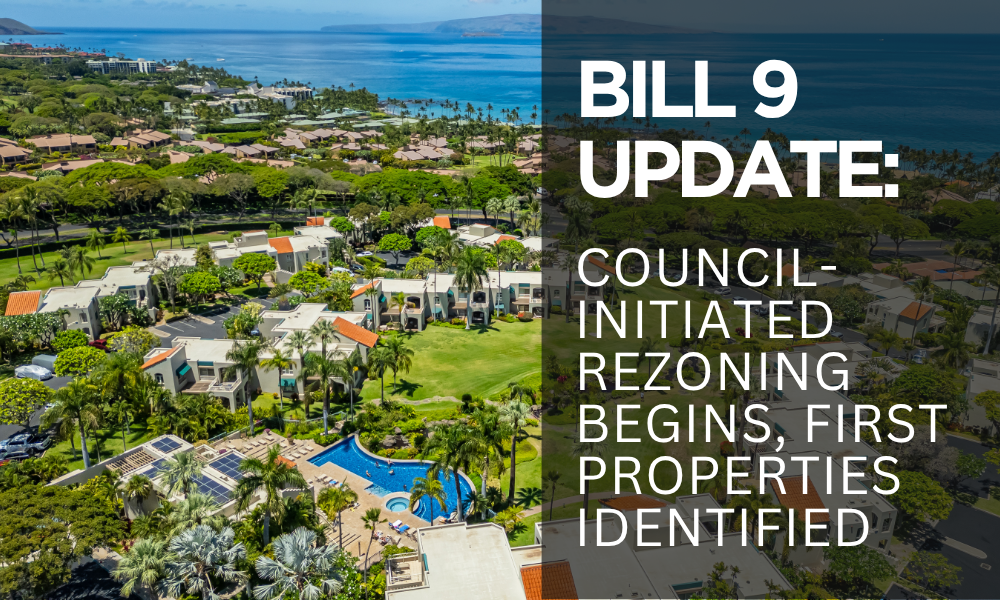
The Maui Bill 9 rezoning process is officially underway. Less than two weeks after the Maui County Council passed Bill 88 on final reading and transmitted it to Mayor Bissen for signature, the Housing and Land Use Committee has scheduled its first action on Council-initiated rezoning for July 1, 2026.
This is faster than most observers expected.
The Maui Bill 9 Rezoning Process Begins:
On July 1, 2026, the Housing and Land Use Committee, led by Chair Nohelani Uʻu-Hodgins, will consider two resolutions to refer rezoning bills to the Maui Planning Commission: Resolution 26-110 and Resolution 26-111. Both resolutions were introduced by Chair Uʻu-Hodgins.
These are not the final rezoning votes. They are the first step in the Council-initiated rezoning process, formally sending the question of specific property rezoning to the Planning Commission for review. From there, the Planning Commission will hold hearings, make recommendations, and return the matter to the full Council for final votes on actual rezoning.
Resolution 26-110: Timeshare, Leasehold, and Smaller Properties
Resolution 26-110 covers a broad category of timeshare, leasehold, and other properties in the A-1 and A-2 apartment districts. The rationale for grouping these properties together is spelled out in the legislation: leasehold properties are difficult to finance and plan for as long-term housing, and properties with fewer than five units carry values that are difficult for the average potential homeowner to afford. Both categories are identified as appropriate for H-3 or H-4 rezoning on those grounds.
The specific properties named in Resolution 26-110 are:
In Ma’alaea: Hono Kai, Lauloa Maalaea, Maalaea Kai, Milowai-Maalaea, and Maui Sunset.
In Kihei: Maui Hill, My Waii Beach Cottage, Indo Lotus Beach House, Villa Moana, Kapu Townhouse, Waiohuli Beach Duplex, and several smaller unnamed parcels on Iliili Road, Uluniu Road, and Halama Street.
In Lahaina: Kahana Outrigger (two parcels), Hale Mahina Beach Resort, Hale Ono Loa, Kuleana (two parcels), Paki Maui III, Paki Maui I and II, and Maui Sands II.
In Kāʻanapali: Kaʻanapali Royal.
Resolution 26-111: Properties Operating Like Hotels
Resolution 26-111 is a narrower and in some ways more compelling category. It covers properties that already operate like hotels in every practical sense, providing front-desk or similar services, employing groundskeepers and other staff, and functioning as full-service visitor accommodations despite their apartment zoning.
There is an important piece of legislative history embedded in this resolution worth understanding. When Bill 9 was under consideration, the Maui Planning Commission itself identified several properties with zoning or community plan designations that already allowed TVR use outright, and recommended the Council consider excluding those properties from Bill 9’s phase-out. Three of those properties, Maui Eldorado, Papakea, and Wailea Ekahi III, are specifically named in Resolution 26-111. The Council is now taking the step the Planning Commission recommended before Bill 9 passed.
The specific properties named in Resolution 26-111 are:
In Wailea: Wailea Ekahi I, Wailea Ekahi II, Wailea Ekahi III, Wailea Ekolu, and The Palms at Wailea I.
In Lahaina: Papakea.
In Kāʻanapali: Maui Eldorado.
For buyers evaluating any of these seven properties, this Council-initiated rezoning referral is a meaningful development. These properties are being identified not just as eligible for H-3/H-4 rezoning, but as already functioning like hotels, which is the strongest possible case for approval when the process moves forward.
Why the Two-Resolution Approach Matters
The distinction between the two resolutions is more than administrative. Resolution 26-111 properties are being advanced on the grounds that they already operate like hotels. That is a stronger and more legally defensible position than the broader timeshare and leasehold rationale in Resolution 26-110, and it is likely to face a smoother path through the Planning Commission review.
For owners and buyers, understanding which resolution covers your specific property, and what the stated rationale for its inclusion is, matters for evaluating the strength of its rezoning case.
Why This Matters: The Council-Initiated Advantage of a Maui Bill 9 Rezoning
For anyone tracking the Maui Bill 9 rezoning process, this Council-initiated approach is the most significant development since Bill 88 passed. In our previous update, we flagged a practical capacity concern: the county processes a limited number of rezoning applications per year, and with 104 eligible properties the timeline could stretch significantly. The Council-initiated approach addresses this directly. Rather than waiting for individual HOAs to fund and file separate applications, the Council is taking the initiative to move specific properties through the process itself.
For properties included in these first two resolutions, the Council-initiated process removes one significant burden from individual HOA boards. They do not need to fund and file their own rezoning applications to be part of this first wave. For properties not yet included, the question of whether to file independently or wait for a future Council-initiated wave is worth discussing with your HOA board now.
What Comes Next in the Maui Bill 9 Rezoning Process
The July 1 HLU meeting is the starting point, not the finish line. Once the resolutions are referred to the Planning Commission, the Planning Commission will hold its own hearings and make recommendations. The matter then returns to the full Council for final votes on the actual rezoning. For properties in West Maui facing a January 1, 2029 sunset date, the pace of this process is directly relevant to how much certainty owners and buyers will have before the deadline arrives.
Bill 9 remains law. The enforcement timeline has not changed: January 1, 2029 in West Maui and January 1, 2031 in other affected districts.
What This Means If You Own, Are Buying, or Are Selling a Condo on Maui
The Maui Bill 9 rezoning timeline is moving faster than expected, and the properties named in these resolutions are now at the front of that line. That is meaningful for owners, buyers, and sellers alike. A Council-initiated rezoning referral for your specific complex removes a significant layer of uncertainty about whether and when your property will seek H-3/H-4 status, and in the case of Resolution 26-111 properties, it comes with the strongest possible legislative rationale for approval.
For owners of properties on the Exhibit 1 list that are not in these first two resolutions, this is a moment to watch the July 1 hearing closely and begin a conversation with your HOA board about timing and strategy. Waiting for a future Council-initiated wave is one option. Filing independently is another. The right answer depends on your property’s specific circumstances.
For buyers, the properties named in these resolutions, and particularly those in Resolution 26-111, are now operating with more clarity about their path forward than the broader pool of Exhibit 1 properties. Whether a property is in the first wave of Council-initiated rezoning, and under which rationale, is worth factoring into any purchase evaluation.
For sellers of properties in the first wave, the news is constructive. Council-initiated rezoning is a concrete development that removes uncertainty and is likely to be felt in buyer interest as the process advances.
We will continue tracking this process and will share updates after the July 1 hearing. If you want to talk through what any of this means for your specific property or situation, we are here.
With Aloha,

This Bill 9 Maui Real Estate update represents our opinion based on available information and should not be considered financial or legal advice.
Frequently Asked Questions: The July 1 Rezoning Hearing and What It Means for Your Property
A great deal about how this rezoning process will actually work remains to be determined. The July 1 hearing is the beginning of a multi-stage process, not the end of the uncertainty. What we know is that the Council is moving, that specific properties have been identified for the first wave, and that the timeline is real. What we do not yet know is how the Planning Commission will respond, how quickly the Council will act on final votes, and what the process will look like for properties outside the first wave. We will continue to track this closely and share updates as the picture becomes clearer. If you want to talk through what any of this means for your specific situation, we are here.
What if my property is on the Exhibit 1 list but not named in Resolution 26-110 or 26-111?
Your property has not been forgotten, but it is not currently in the active Council-initiated rezoning pipeline. The Council appears to be rolling out rezonings in sequential waves, starting with the clearest candidates, but how many waves there will be and when they will happen has not been determined. If your property is not in this first wave, you have two options to consider: wait to see if a future Council-initiated wave includes your property, or work with your HOA board to evaluate filing a private rezoning application independently. Neither path comes with guarantees, and a great deal about how this process will unfold remains to be determined.
Can my property still apply for H-3/H-4 rezoning if it is not in the first wave?
Potentially, yes. The Exhibit 1 list establishes a starting point for eligibility, but being on the list does not guarantee approval, and being excluded from the first Council-initiated wave does not permanently close the door. What we do not yet know is how the county will manage the volume of applications, what the approval criteria will look like in practice, and how long the process will take. These are questions that will be answered over time as the rezoning process develops.
How long will it take for properties in the first wave to be rezoned?
No one knows yet. After the July 1 HLU hearing, the resolutions go to the Maui Planning Commission for review and recommendation, then return to the full Council for final votes. Given that all three Planning Commissions previously recommended denial of the Bill 88 framework, it is reasonable to expect the review to be thorough. For West Maui properties facing a January 1, 2029 deadline, the timeline is a real concern, but the actual pace of the process is something we will only understand as it unfolds.
What does it cost for a property not in the first wave to file its own application?
Based on testimony at the Bill 88 final reading, land-use planners have quoted between $200,000 and $500,000 per property to prepare the studies currently required. However, the Council heard these concerns, and there may be efforts to streamline the process. What the actual cost and requirements will look like for properties filing independently is not yet fully defined. HOA boards should begin having these conversations now, but the full picture is still developing.
What if my property is not on the Exhibit 1 list at all?
Properties not on Exhibit 1 do not currently have a clear pathway into the H-3/H-4 rezoning process under Bill 88. The bill requires the Department of Planning to maintain and publish this list, and there may be a process for properties that believe they were incorrectly omitted. But how that works in practice has not been defined yet. The starting point is a direct conversation with the Maui County Department of Planning.
Should my HOA be doing anything right now?
The most important thing any HOA board can do right now is start the conversation. Whether your property is in the first wave or not, there are decisions ahead that will require preparation and owner alignment. If you are in the first wave, understand what the process that is about to begin will require of your community. If you are not in the first wave, begin evaluating your options and what each one could mean for your property’s long-term use. We do not yet know exactly how this process will unfold, but the communities that are prepared and organized will be in a better position than those that wait for certainty that may not come quickly.
Can I testify at the July 1 hearing?
Yes. The July 1 HLU Committee meeting is a public hearing. The Committee may also consider adding or removing properties from the resolutions at that meeting, so testimony from affected owners could matter. Oral testimony is available online via Teams at http://tinyurl.com/HLU-Committee and in person at the Council Chamber, 8th Floor, 200 South High Street, Wailuku. Written testimony can be submitted via eComment at mauicounty.us/agendas or emailed to HLU.committee@mauicounty.us. Oral testimony is limited to three minutes per agenda item.
Interested in learning more about Maui Bill 9?
Follow our coverage of the major developments:
- Bill 9 Update: Timeline, Impact, and What Maui Property Owners Should Expect
July 2025: An overview of Bill 9, the proposed phaseout and what it could mean for Maui property owners. - Bill 9 Update: New Hotel Zones Proposed to Protect Vacation Rentals
October 2025: The Temporary Investigative Group recommends creating H-3 and H-4 Hotel Districts and identifies properties for potential rezoning. - Bill 9 Update: Bill 9 Passed, What Happens Next
December 2025: Bill 9 becomes law and the focus shifts to implementation. - Maui Bill 9 Update: All Three Planning Commissions Have Now Recommended Denial
April 2026: All three Planning Commissions recommend against the proposed H-3/H-4 zoning framework. - Maui Bill 9 Update: H-3/H-4 Hotel Zoning Framework Clears Council Committee
May 2026: The H-3/H-4 framework advances from the Housing and Land Use Committee to the full Council. - Bill 9 Update: The H-3/H-4 Zoning Bill 88 Passes First Reading
June 2026: Bill 88 passes its first Council reading and the potential H-3/H-4 property list comes into greater focus. - Bill 9 Implementation Update: Council-Initiated Rezoning Begins, First Properties Identified
June 2026: The first properties are identified for Council-initiated H-3/H-4 rezoning. - Bill 9 Implementation Update: Council Advances First Maui Vacation Rental Rezoning Resolutions
August 2026: Resolutions 26-110 and 26-111 advance to the Maui Planning Commission for property-specific rezoning review. - Maui Vacation Rental Rezoning Update: More Properties Considered for H-3 and H-4 Zoning
September 2026: Council considers additional properties and criteria for H-3/H-4 rezoning, including coastal-hazard properties. - Maui Planning Commission Recommends 5 of 48 Properties for H-3/H-4 Rezoning as 32 More Head to Planning Commission
October 2026: The Planning Commission recommends H-3/H-4 rezoning for 5 of 48 properties, while Council refers another 32 properties for Planning Commission review.
View all Maui Bill 9 updates Here